Showing posts with label Le Marche. Show all posts

Friday, March 9, 2012

Ceramics in Appignano - Le Marche

The outside of the ‘Ceramiche Fratelli Testa’ pottery workshop in Appignano di Macerata is covered in a striking kaleidoscope of colourful tiles inviting you to enter. Inside, the doors, walls and ceiling are decorated with colourful pieces of pottery and hundreds of mosaics.

Ceramiche Fratelli Testa, Appignano di Macerata


Detail of exterior

When we visited we were able to watch the potters at work and to view the process from beginning to end was fascinating. We could see the vessels take shape and become beautiful works of art, smooth, glazed and painted. The creator of all this magic is Giuseppe Testa, the last of the Testa potter brothers (Fratelli Testa) in Appignano di Macerata.

In 1850 his grandfather (also named Giuseppe) set up the pottery workshop and since then the family of skilled craftsmen, his father Giacinto and his brother Francesco have all been potters.

Giuseppe started creating pottery when he was just eight years old. His work requires great skill but he does it with a passion. While he works there he makes all his customers feel at ease in his cozy studio and often in the evenings, the older Appignanesi meet here to chat.

Postcard of Borgo Santa Croce from 1860
(you can see the pottery lined up on the left)
He is still creating ceramics at the age of 74 and teaches in the local school of ceramics passing on his skills to the next generation of potters, helping to preserve the history, culture and traditions of Appignano. You can buy his wonderful creations in the shop.

Although his son Mauro shares his love of ceramics he has chosen a different career, as an architect. It was Mauro who decorated the interior walls and ceiling of the ceramics shop. The pottery is mostly for everyday use, rustic earthenware dishes, terracotta crockery, bowls, vases, jugs and pitchers.The richness of this ancient craft continues to live on every day in the dazzling shop front and each piece of pottery retains a part of this wonderful tradition.


I treasure this pestle and mortar made by Giuseppe Testa
Symbol of the Bottega dei Fratelli Testa

Thanks to our friend Stefano Serrani  for much of this information about his dear friend Giuseppe Testa. Thanks also to Bob of the beautiful Casal dei Fichi apartments near Fermo for more updated information. You can visit the ceramics store here:


Ceramiche Fratelli Testa
Borgo Santa Croce, 33
62010 Appignano di Macerata (MC)
Tel.: (+39) 073357484

Further reading: The Town of Appignano di Macerata

Wednesday, March 30, 2011

The town of Appignano di Macerata

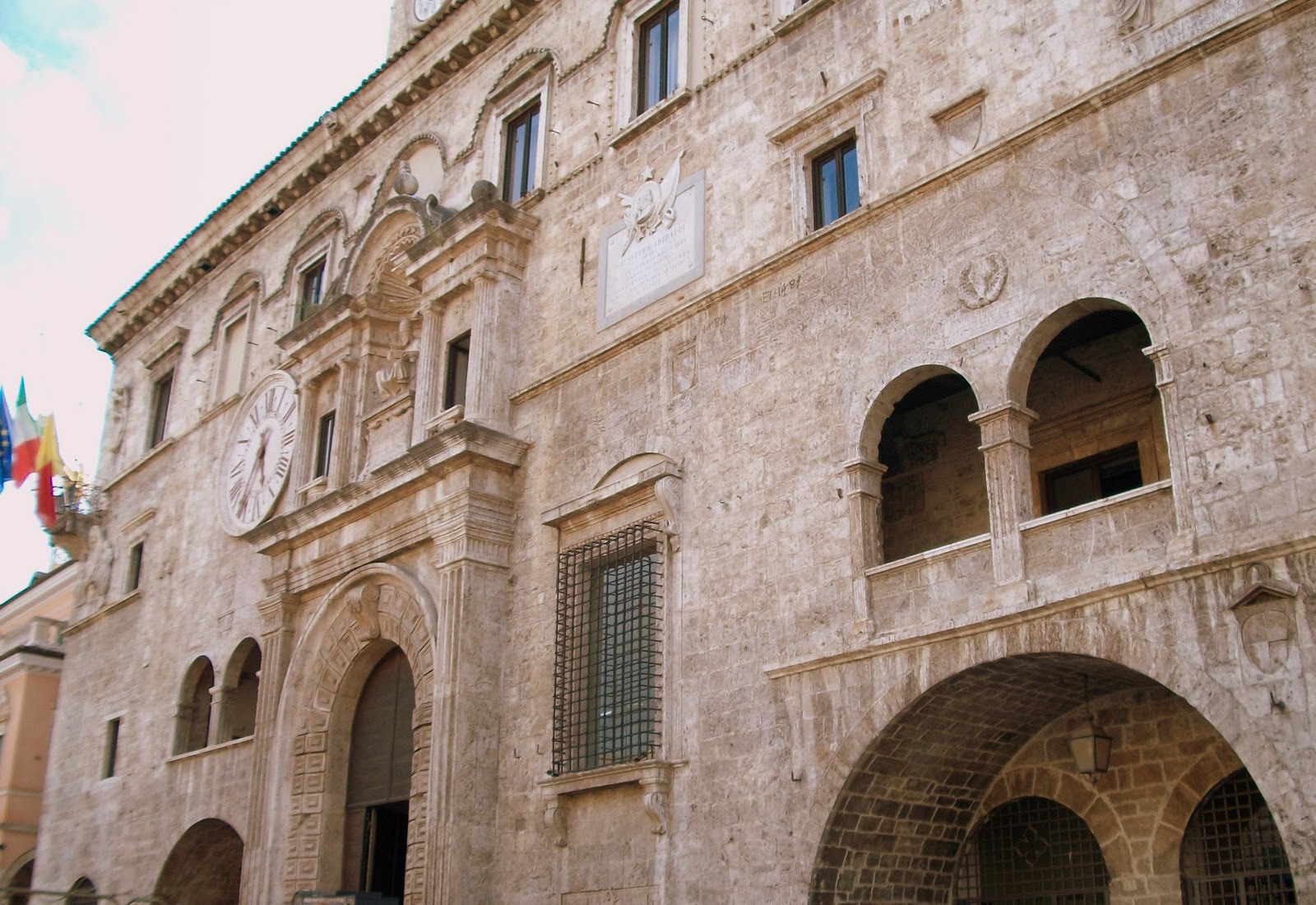
The Town Hall in Appignano di Macerata
Whenever we’ve visited Le Marche we’ve always stayed with good friends in the pretty hill town of Appignano di Macerata (see map), in the heart of this picturesque region. It is situated exactly half way between the sea and the mountains, just a 30 minute drive each way. Not to be confused with Appignano del Tronto further south in Ascoli, this medieval town is known nationally for its production of ceramics (produced here for over 500 years) furniture and clothes.
The origins of Appignano date from Roman times. Appignano di Macerata is a charming town, 200m above sea level with a population of about 4,000 and about 10 kilometers from the provincial capital Macerata. The friendly people and the lifestyle here is very similar to what I’ve witnessed in Abruzzo. What I love about Appignano is how the locals:

• go to the bar in the morning for their cappuccino or caffe latte and a pastry
• chat with their friends and neighbours in the street
• break for a two hour lunch during the day and have a family meal around the kitchen table
• spend their evenings outdoors: the women sit outside in the street knitting or crocheting and chatting together and the men congregate in groups and play cards
• the children play outside even when it is dark
• the people call out to one another from across their balconies


These balconies are like little sanctuaries: cozy, romantic and fragrant
  There are many monuments of art and architecture to be seen in Appignano:
John and Stefano outside la Chiesa di San Giovanni Battista
  • La Chiesa di San Giovanni Battista (St John the Baptist), built in the 16th century and renovated in the 18th century.
  • La Chiesa dell'Addolorata (Our Lady of Sorrows) built for the first time in the Middle Ages and rebuilt in 1746. 
  • Il Convento di Forano 1473, known for having hosted, according to tradition, St Francis of Assisi. 
  • Villa Tusculano, a villa built in the Napoleonic era under the patronage of Count Leopoldo Armaroli. 
  • Villa Forano – Winery. The Cellar is open everyday for winetasting from 8:30 to 12:00 and from 15:00 to 19:00 (except Thursdays and Sundays).
Events in Appignano

Like most towns throughout Italy, Appignano has its own special events that are unique to the area. During the first week of July, for three evenings, a festival called Bellente il Brigante takes place in the town hall square. It is a traditional dinner for about 180 people with typical dishes of the 19th century. More than 70 actors in period costume, extras, musicians and dancers represent the history to the spectators. Around the guests, the actors evoke the habits of Appignano’s inhabitants in 1812, when life was influenced by the contradictions of the Napoleonic state and by the legacy of the papal authority. Among the events of the period that are represented in this festival, there are the stories of the young Appignanese hero Pietro Masi and other characters who actually existed. The spectators are comfortably seated at long tables and enjoy local recipes from the 800s, served in typical bowls handmade by local artisans. The aim is to give tourists the opportunity to experience Appignano’s local traditions, culture, folklore, food and wine.
http://www.youtube.com/watch?v=1JnqbFUNu3U

If you are interested in attending one of these evenings contact the Pro Loco of Appignano in Piazza Umberto I (Tel. 338 7878472) or send an email to prolocoappignano@alice.it

In mid-October Appignano hosts another gastronomic event called Leguminaria. It is dedicated to legumes (chickpeas, beans, lentils and roveja). Roveja is the dialect name for field pea which is only grown in the Sibillini Mountain National Park in Le Marche. All of the dishes are prepared according to traditional recipes and are served in earthenware bowls specially made for the occasion by Appignano’s master potters. Everyone who attends the meal can take home their bowl as a souvenir of the occasion. Much appreciated by lovers of rural tourism, the town of Appignano di Macerata is ideal for short or long term stay and is devoted to well-being and culture.
http://www.youtube.com/watch?v=rDgryWs7rKg

*******************************************
Our friend Stefano kindly gave me local information about the best places to stay in Appignano, the bars, restaurants and pizzerias. Here is what he said about them:

Where to stay in Appignano:

"Osteria dei Segreti: located at the edge of Appignano is a very nice, quiet place in the middle of the countryside. There is a lovely panorama in front of the Sibillini mountains. It has good food with a nice price. They have 6 rooms and 6 small apartments to rent. This what their website says about the local cuisine:
Osteria dei Segreti
Rustic ambience and family oriented for a taste of local flavors, such as: cappellacci (pasta shaped like little hats) with fonduta (melted cheese) and truffles, gnocchi with a traditional meat sauce and ‘cargiù’ with porcini mushrooms and cherry tomatoes, grilled crescia (onion flavoured focaccia) the perfect complement to the delicious salami and pecorino Sibillini.

Villa Verdefiore
 Villa Verdefiore: hotel (agriturismo) and restaurant located on the edge of town with lovely rooms. A very nice place with a huge park all around it. Good for weddings, celebrations and meetings. Good food, price middle/high.
  La Colombaia: A beautiful country house with a Wellness Centre located at the edge of Appignano. Good food, middle/high price. Lovely outdoor swimming pool.


La Colombaia
 Where to Eat:

 - Ristorante Lord Byron, located in the historical main square. They serve home made food, typical of Le Marche; nice place, nice people, nice price!

 - Ristorante Le Grazie, situated not far from the centre. They also serve home made food. It is an old style restaurant for good food and a good price.

 Bars/Cafés in Appignano
 - Bar H, located in the industrial area of Appignano. Young people meet there. Bar H in Italian sounds like "baracca" which means chalet or cabin. In fact it is made of wood like a mountain cabin... in the middle of the industrial area!

 - Bar del Borgo: located in the borgo of Appignano. Middle aged and older people meet there.

 - Bar White Lady: located near Giuseppe's pottery shop Ceramiche fratelli Testa .Young people meet there. In Stefano’s opinion this one is the best bars in town.

 - Bar Giardino dei Tigli: located on the 'monte' of Appignano. We went there to have an ice cream last summer. Most young people meet there during summertime.
There are two pubs in Appignano and you can get a very good takeaway pizza at Pizza E Vai.

 - Dal Tramonto all'Alba Pub: nice place located in an old Italian cinema's room. The son of Giuseppe the potter, Mauro Testa, designed the interior. On Saturday and Sunday evenings families go there to have pizza for dinner because they serve great pizza. Sometimes they play live music.

 - La Cantina del Porto: located in the borgo. Nice place with good music, sometimes they play live music here also. There is an old story concerning Appignano when many years ago in Appignano there was a small port. Appignano has a little river called Monocchia. At the beginning of the 900s women went there to wash their clothes. Men went there too - to see the women's legs when they hitched up their long skirts! Stefano likes to think that this story is true. When older people meet a person from Appignano they say:
(In dialect): “Ah! Venghi da Pignà. Ce ru ‘portu’ de Pignà, ce vinio da gioenottu a vedè re gamme de re donne!”
(In Italian): Ah! vieni da Appignano. C'è il ‘porto’ ad Appignano. Ci venivo da giovane a verdere le gambe delle donne!
(In English): Ah! You come from Appignano. There is a port in Appignano. I used to go there when I was young to look at the women's legs! "

********************************************

Last but not least, Appignano has its own rock stars! They are a Rolling Stones tribute band who call themselves The Kingstones. Ciccio (Alessio), Stefano’s brother, is an excellent guitarist. They usually play in the nearby town of Macerata and went on tour last winter playing in Milano, Napoli and Salerno and it was a big success. Have a listen here and see how great they are! (Ciccio is wearing the black sleeveless shirt).


One of my favourite memories of our time in Appignano is of the night of San Lorenzo when Ciccio and Stefano serenaded us on a nearby hilltop while we watched the falling stars. It is a night I will remember forever…

Photo credit: Town Hall Appignano http://www.progressonews.com/index.php/2010/11/appignano-ancora-bandiera-verde

You might like: Ceramics in Appignano

Wednesday, February 9, 2011

The town of Treia, Macerata

Treia, Macerata
photo credit: gillpoll
Treia (see map) is a quintessential hill town in the heart of Le Marche filled with Romanesque, Renaissance and Neoclassical architecture. We were fortunate to be invited to dinner by Dan and Maria, a lovely American couple who run a gorgeous B&B there ‘Villa Trina’. It is easy to see why they chose to live there. It is surrounded by the most beautiful countryside and has stunning panoramic views from the Apennine Mountains to the west and the Adriatic to the east. There is much to see and do in the local area. The town itself has:
  • A medieval cathedral (one of the largest in the region) - Cattedrale di SS Annunziata
  • Torre dell’Onglavina - the remains of a castle on a rocky spur
  • Thirteenth century Palazzo Pretorio
  • A large piazza with a horseshoe-shaped balustrade offering breathtaking views
  • A Civic Museum
  • The Church and convent of S. Filippo
  • The Georgic Academy
  • The 17th-century Town Hall with a collection of Renaissance and classical paintings
  • The Museo Civico Archeologico also includes Egyptian religious statues of the Roman period.
  • Santuario del SS. Crocifisso, a  large early 20th-century church complex


Santuario del SS Crocifisso
(courtesy of Pro Loco Marche)
  Turreted boundary walls and gates maintain the medieval aspect of the elegant, charming town of Treia perched high on a hill, untouched by mass tourism. For its beautifully preserved historical center it is included among the Borghi più belli d'Italia.

Unusual Ball Game in Treia

In July we saw posters around the town for ‘Disfida del Bracciale’. Our friend Stefano explained that Treia is famous for hosting a traditional ball game dating from Renaissance times called The Challenge of the Armlet (also known as Pallone col bracciale).

Pallone col Bracciale (Wikipedia)
He said that it was similar to tennis but instead of racquets, the players use a device called a ‘bracciale’- a sort of wooden cylindrical spiked glove worn over the hand and forearm. A hard leather ball is pounded back and forth between two teams of three, with a high wall (between 14 and 20m) on one side, permitting deflection back into the field of play. The court is very long - around 90m. Scores are the same as in tennis – 15, 30, 40, game – and the first team to win six games is the victor. The Challenge is preceded by costume processions and ceremonies, evoking the times of Carlo Didimi, the greatest player of pallone. Each year the challenge is held on the first Sunday of August, following ten days of festivities that start on the Friday before the second last Sunday in July. This unique festival ends with a magnificent fireworks display.

Typical Local Dishes of Treia

The “calcione” is one of the most famous typical products of Treia. Each year in mid-May the Sagra Del Calcione e Del Raviolo is held in Piazza della Repubblica. Calcione is made from flour and eggs, lightly sweetened, turned and folded into a half moon shape and filled with eggs, pecorino, sugar and oil. Il Raviolo is filled with ricotta cheese, eggs and nutmeg and served with ragù di carne and parmigiano. There are two versions, one is fried and the other is baked in the oven. They are served with the excellent local wine Vernaccia di Serrapetrona. In May Treia also hosts the Sagra dell’Oca (Festival of the Goose). Typical of the area are also:

• Ciauscolo - a delectable, spreadable salami.
• Porchetta with grilled polenta.
• Coniglio alla cacciatora (rabbit stew hunter-style).
• Scroccafusi (Castagnole marchigiane)  – a pastry of flour, eggs, sugar, aniseed and lemon zest.
• Cicerchiata - balls of fried sweet dough joined into ring shapes by warm honey.

Piazza della Repubblica, Treia
photo credit: e. ciaralli
 Treia is also an ideal place from which to explore other towns in Italy, with Perugia, Bologna, Florence, Assisi, Pescara, Siena and Rome all day-trip possibilities. Closer still are the university town of Macerata, just a 15 minute drive away and the Thermal Baths in Tolentino, just 18km (11 miles) to the south. I would recommend hiring a car for getting around this area as it is not served by railway and buses are infrequent, but this ensures its tranquillity.

Sunday, January 16, 2011

The Best Places to Visit in Le Marche

Le Marche, Italy in one Region
“If one had to decide which Italian landscape was the most typical,you’d have to choose the Marche …with its range of landscapes, it is a distillation of Italy.”
Guido Piovene, Viaggio in Italia, 1957
The central region of Marche is a well guarded secret, but once you discover it you are completely captivated and mesmerized by its beauty, just as I am.

The region is bordered in the west by the Apennine mountain range with ski resorts and hiking trails. Between the Apennines and the Adriatic coast is a glorious hilly landscape with traditional farming of cereals, vineyards, olive groves and sunflowers. Every few kilometres you come across pretty hilltop villages, fields of gold, sparkling rivers and lakes, castles, fortresses and medieval walled towns. The 180km of Adriatic coastline is lined with a stretch of spectacular blue flag beaches. The region is full of history, art and culture with Romanesque and Renaissance churches, abbeys, monasteries and sanctuaries surrounded by sweet, gentle hills. Many of the greatest architects, artists and writers of the Renaissance period were from Le Marche - Raffaello Sanzio (Raphael), Donato Bramante, Rossini, Giacomo Leopardi and Gentile da Fabriano.

Le Marche has many restaurants with excellent quality and value and boasts an exquisite wine collection including Verdicchio dei Castelli di Jesi and Rosso Conero.

My favourite food of Le Marche is Vincisgrassi (a type of lasagne made from veal, lamb and porcini mushrooms) and John's is Brodetto Marchigiano (a stew with up to 13 different types of seafood).

Vincisgrassi


Brodetto Marchigiano
For more about the cuisine of Le Marche see this web site: http://www.knowital.com/lemarche/

My Top 5 Places in Each Region of Le Marche
Le Marche is divided into five provinces. Here is a list of my favourite attractions in each province (of the ones I’ve seen to date, since first visiting in 1995) and there are so many more places that I haven't seen yet! Of course this list is highly subjective – so please let me know which attractions I have left out and the ones that you would recommend...

Urbino - Palazzo Ducale
Photo credit: Dean Ayres
Province of Pesaro & Urbino -
1. Gradara: A medieval fortress, which was the setting for Dante’s Inferno.
2. Urbino & nearby Urbania: A Renaissance jewel, the birthplace of Raphael.
3. Pesaro: The birthplace of Rossini, which hosts an Annual Opera Festival.
4. San Leo: This spectacular ancient town on a rocky outcrop is a landmark for miles around.
5. Fano: City of Art, beautiful piazza, modern chic shops, and a huge marina.
********************************************
Monte Conero Coast - Ancona Province
(Le Due Sorelle - Sirolo)
photo credit: Marck Wells
Province of Ancona –
1. Genga: The Frassasi Caves
2. Loreto (and nearby Porto Recanati): Important place of pilgrimage for the Virgin Mary.
3. Jesi: The hills surrounding Jesi produce the well known Verdicchio and some excellent red wines such as Rosso Conero and Lacrima di Morro d’Alba are also produced in the area. Jesi is the birthplace of Federico II and has four palaces.
4. Monte Conero Coast & National Park and nearby Sirolo: magnificent coastline and splendid bays.
5. Fabriano: Famous the world over for its production of the finest art and writing papers.
********************************************

Sferisterio di Macerata
Province of Macerata –
1. Macerata: It is a truly magical experience to attend the opera on a warm summer's night  in the 4,500 seat Sferisterio arena with candles flickering in the darkness and stars twinkling overhead.
2. Treia: Known for hosting an unusual Renaissance ball game and a fantastic cooking festival in mid-May.
3. Recanati: Birthplace of Giacomo Leopardi.
4. Cingoli: Hill-town surrounded by forests, with a sweeping panorama to the Adriatic.
5. Appignano di Macerata: Surrounded by amazing scenery and known for its furniture and pottery.
*******************************************
Torre di Palme - Fermo
Photo credit: Giuseppe Desideri
Province of Fermo – (new province since 2009)
1. Moresco: You can find many castles and churches with frescoes here.
2. Fermo: Town with many historic attractions including the memorable Palazzo Romani Adami.
3. Torre di Palme: A visit to the romantic Il Galeone Osteria is a must.
4. Porto San Giorgio: An ancient fishing port.
5. Porto Sant’Elpidio: Beautiful coastal town.
*********************************************
Grottamare - Ascoli province
Province of Ascoli –
1. Ascoli Piceno: Perhaps the most elegant town in Le Marche. Interesting food and architectural gems can be found in this relatively undiscovered medieval town.
2. Grottamare: Exotic beach with golden sands and pine trees.
3. Cupra Marittima: Picturesque seaside resort with a unique shell museum.
4. Sibillini National Park: Winter sports and ancient mountain passes.
5. San Benedetto del Tronto: The second most important fishing port in Italy. It is one of the main seaside resorts 'Riviera della Pale' on the central Adriatic coast and has a long beach of fine white sand and shallow water.

Map of Le Marche with clickable places to visit courtesy of the Le Marche Tourist Dept can be seen here:

Have you been to Le Marche? What do you think are must-see places there?


Moreno Moretti organizes exciting activity holidays in Le Marche: truffle hunting, vespa and classic car tours, hiking in the Sibillini Mountains, visiting wine cellars, taking cooking classes, quad biking etc. For more details have a look at his great website:

Tuesday, November 16, 2010

Piazza del Popolo - Ascoli Piceno

When I first entered Piazza del Popolo, the beauty of the surrounding buildings took my breath away. This large square in the heart of Ascoli Piceno (see map) paved with gleaming travertine and flanked by Renaissance porticoes, is the setting for the city's finest buildings - the Palazzo dei Capitani, the Church of San Francesco and a line of lovely colonnaded stores (the Loggia dei Mercanti).

Piazza del Popolo - the heart of Ascoli Piceno
Piazza del Popolo- The People’s Square - is the place where everyone gathers to meet, to watch, eat, shop and take their evening stroll, the passeggiata. There are many restaurants here serving local cuisine at reasonable prices. Another wonderful thing about this piazza and nearby Piazza Arringo, is that they are traffic free zones so you don’t have to worry about a car or a scooter startling you as you stroll around. This gives the town a very special ambience of tranquility and serenity and makes it magical by both day and night.

View of Sibillini hills from Piazza del Popolo
Surrounding the town are the Sibillini hills and only thirty minutes away is the beach at San Benedetto del Tronto, making it a perfect location, well serviced by public transport. It is a thriving town with a well-preserved historic centre. Its pretty side streets are like warrens, inviting you to explore them. Everyone we met was really friendly. For example, when we entered Palazzo dei Capitani, the woman at the desk offered to give us a guided tour. The façade of this building has a sculpted portal with a monument to Pope Paul III and a beautiful large stone clock. Inside she showed us the pretty three-tiered Renaissance courtyard surrounded by arcades, the seat of council on the first floor and an underground archeological route with Roman ruins below.

Palazzo dei Capitani


View of Loggia dei Mercanti from Palazzo dei Capitani

Our friend Stefano suggested that we have a caffe corretto all’anisetta in the adjacent building, the famous                Caffè Anisetta Meletti.
 Anisetta is a sweet, delicious aniseed-flavoured liqueur. It gave us a warm feeling as we sat beneath the frescoed porticoes with elegant arches and watched the action in the square. The service was very attentive, but not intrusive. This Café has been featured in many films, commercials and photo shoots.
Caffe Anisetta Meletti - Piazza del Popolo


Caffe corretto all'anisetta
In business since 1907, the interior retains its Art Deco style, with rich, warm woodwork and a décor that takes you back in time. I was especially drawn to the round Carrara marble topped tables with scenes from films that were set in this café, the most famous of which is possibly

A scene from 'I Delfini' (1960)
Left to right: Anna-Maria Ferrero, Gerard Blain, Claudia Cardinale

Tabletops in Caffe Meletti
Next we went to the Church of San Francesco at the top of the square. It has three gothic portals sculpted from travertine and two bell-towers. Inside, the stained-glass windows have different stories to tell as they filter light throughout the interior. In the left nave is a crucifix that miraculously survived a fire and is reported to have spilled blood twice.
Interior of Chiesa di San Francesco
Last but not least, the Café Lorenz to the left of the church sells takeaway stuffed olives, a speciality of the region called “Olive all’Ascolana”. I usually find green olives quite bitter but was encouraged to try these and discovered they were surprisingly delicious! They are large green Picene olives, stuffed with mixed meats, usually pork and veal, breaded, deep fried and served hot. You can also find these in Piazza Arringo at a vendor named Migliori.

Takeaway  'Olive all'Ascolana'
In the opening scene from the film 'I Delfini' there is a marvellous panorama of Ascoli Piceno followed by atmospheric shots of Piazza del Popolo and the exterior of Caffe Anisetta Meletti.


I hope that between this and my previous post, I’ve given you enough reasons to take a day trip to amazing Ascoli Piceno.

Sunday, October 31, 2010

A Day Trip to Ascoli Piceno, Le Marche

We visited the stunning medieval town of Ascoli Piceno (see map) in Le Marche on the first Sunday in August, which luckily for us, coincided with their annual celebration of the Quintana. The Quintana is a historical medieval jousting tournament held on the feast day of Sant’Emidio, the town’s patron saint. When we arrived it looked as if we had stepped onto a film set, as we were transported back to another era. Hundreds of townspeople, dressed in full ceremonial 15th century costume, colourful flag-throwers (sbandieratori) and trumpeters marched past us along the main street to a steady drumbeat. There was a real carnival atmosphere in the town.

Piazza Arringo was their destination. This huge travertine-paved piazza, that shines like marble, is absolutely breathtaking and surrounded by magnificent architecture. A religious procession followed, in which the statue of Sant’Emidio was carried on the back of a cart drawn by two oxen to the Cathedral of Saint Emidio.

Statue of Sant'Emidio being transported to the Cathedral

Piazza Arringo - Cathedral of Saint Emidio with Baptistry of Saint John to its left

Beautiful interior of the Cathedral of Saint Emidio
Masterpiece by Carlo Crivelli in the Cathedral of St Emidio


Detail of ceiling in Cathedral of St Emidio

At both ends of this piazza are pretty twin fountains, depicting dragons, seahorses and a dolphin like figure on the top. In Piazza Arringo you will also find the Municipal Art Gallery La Pinacoteca Civica, with one of the richest collections of religious paintings in Italy, including works by Carlo Crivelli, Titian, Tintoretto and Guido Reni.

Fontana di Piazza Arringo
Six knights came by with the banners of their districts displayed behind them. What we didn’t realise at the time, was that the jousting tournament (La Quintana) was going to take place in the local stadium after the procession. The six knights ride a course one after the other trying to hit an effigy of a warrior. Strength and agility are necessary for the knight to win the palio or grand prize

Knight of Porta Solestia
Once the excitement of the parade was over we strolled around the charming piazza admiring the elegant buildings. We got a glimpse of the rest of this beautiful town from the quaint narrow side streets. I would have loved to have had more time to explore its many alleyways, bridges, pretty shops underneath the porticoes and its many towers. Ascoli Piceno is also known as the 'town of 100 towers' although there are 'only' 50 of them left today.

The Twin Towers of Ascoli in Piazza Sant'Agostino
Since the late 1300s, competitions for flag-throwing and archery take place during weekends in July with the main event, the Quintana, held in August. For the citizens of Ascoli Piceno these festivals are the expression of a rich history inextricably linked to their territory. Many of the town’s population of 51,000 participate in these events which connect them to age-old traditions and every detail of these celebrations is orchestrated to perfection. I felt privileged to have witnessed this fascinating ceremony. Even without this impressive festival, Ascoli Piceno is a very captivating town and well worth visiting at any time of the year.

Piazza del Popolo nearby, is surrounded by magnificent buildings such as the Palazzo dei Capitani, the Loggia dei Mercanti, the Gothic church of San Francesco and the famous Caffè Anisetta Meletti. There is so much more to see in this piazza alone, so I will leave that for the next post. One day is just not enough to experience all of the wonders of Ascoli Piceno!


Map of Ascoli Piceno
How to get to Ascoli Piceno by car, bus or train
Hotels in Ascoli Piceno