Showing posts with label Abruzzo. Show all posts

Sunday, September 30, 2012

Hermitages and Churches in Abruzzo

Last month we took an amazing excursion with Daniele of http://www.abruzzowithyou.com/ to two hermitages of extraordinary beauty, two abbeys and a magnificent hill-town church. Included in his itinerary were:

• Eremo San Spirito a Majella
• Eremo San Bartolomeo in Legio
• Abbey of Santa Maria d’Arabona
• Abbey of San Liberatore a Majella
• Chiesa dei Santi Valentino e Damiano

They are not easy to get to using public transport, so going there with a knowledgeable guide like Daniele is the ideal way to visit them.

Daniele picked us up after lunch outside our rented apartment in Montesilvano. First we came to the Cistercian abbey of Santa Maria d’Arabona in Manoppello.

Rose window in Santa Maria d'Arabona

Lily pond outside Santa Maria d'Arabona
Next we saw the beautiful abbey of San Liberatore a Majella in Serramonacesca. We took the enchanting path behind the abbey along the Alento River past ancient rock tombs, pools and little waterfalls.

San Liberatore in Serramonacesca
Mosaic floor of San Liberatore
Ancient Rock Tombs behind San Liberatore

Chiesa dei Santi Valentino e Damiano

The striking church of Saints Valentino and Damiano with its twin belltowers is in the gorgeous hill town of San Valentino. The church, which was built from stone from the Majella in the second half of the 18th century, was designed by the noted architect Luigi Vanvitelli, who also designed the palace at Caserta near Naples. In front of the church, between the two flights of steps which lead to its door, is the lovely Fountain of Sansone.

Chiesa dei Santi Valentino e Damiano
If you are ever in the little hill-town of San Valentino, I recommend that you taste their homemade ice-cream 'Crema di San Valentino'.


Eremo San Spirito a Majella

The picturesque hermitage of Eremo Santo Spirito is immersed in the fabulous scenery of the Majella Mountains. Unfortunately it was closed when we got there. Had it been open we would have been able to see a simple church, sacristy, monastic complex, chapter hall, library, winter chapel and refectory. Celestine V lived there from 1274 to 1276 before he became Pope. With a car you can drive to within 100 metres of this hermitage.

Eremo San Spirito

Eremo San Bartolomeo in Legio

We had a very enjoyable half hour walk through the Majella National Park on the way to the Hermitage of San Bartolomeo, which was the highlight of our trip. It is in an isolated spot but the walk there is not too difficult and the landscape is absolutely stunning.

Majella National Park
The hermitages rises beneath a rocky spur that covers it completely. The refuge itself can also be reached from the other side by a 'sacred staircase'. The only furnishings inside are the simple altar holding a statue of Saint Bartolomeo and a few wooden chairs along the side walls.

Eremo San Bartolomeo
When we arrived the only other person there was a mysterious, bearded, long haired, barefoot man dressed in orange robes. He pointed to my camera and waved his finger as if to say not to photograph him. He had piercing brown eyes that I will never forget. He had lit some incense inside the small chapel which wafted through the air and contributed to the atmosphere of calm. I kept my sunglasses on inside because my eyes were welling up with tears with the indescribable sense of peace that I felt there. This place has an ancient energy and being there was truly a spiritual experience.

Sacred Stairs Eremo San Bartolomeo

(John took these two photographs with his mobile phone.)

For more information about this hermitage, go to Sammy's blog www.lifeinabruzzo.com where she wrote a superb detailed account of her visit to the Hermitage of San Bartolomeo. Noel from www.abruzzo.com added exquisite close-up photos of the wildflowers and butterflies that he took the time to photograph along the way in his post entitled 'A Sanctuary in the Majella'.

We ended the day with delicious dinner in Osteria Belvedere in Roccamorice. Passing through that town in the evening we could see many of the townspeople out on the streets, chatting and eating together at outdoor cafés and restaurants in a warm, lively atmosphere. It was beautifully lit up and was the kind of town that I'd like to spend more time in, to return to in order to get to know it better...

Last year we took other great tours with our excellent guide Daniele. I wrote about them here:

Journey to San Giovanni in Venere Abbey, Abruzzo
Trabocco Punta Torre, Abruzzo Coast
Cookout in Campo Imperatore
Spellbinding Santo Stefano di Sessanio

Thursday, February 9, 2012

Journey to San Giovanni in Venere Abbey, Abruzzo

On the day that we visited Trabocco Punta Torre with Daniele he also drove us to the Punta Aderci Nature Reserve. It is a stunningly beautiful area of great botanical and geological interest and is an ideal spot for birdwatchers, swimmers and sunbathers. From this beach dolphins can sometimes be seen in the distance.
We also stopped in San Vito Chietino and walked along the gravel path past the old train station.

Ahead of us we could see the Trabocco D’Annunzio (also called Trabocco Turchino) and the Eremo D’Annunzio concealed amongst the cliffs and orange trees. The steep cliffs alternate with small sandy coves. The famous poet and writer Gabriele D’Annunzio spent two months of the summer of 1889 here with Barbara Fraternali Leoni. The artist Francesco Paolo Michetti recommended this place to him due to the unspoilt beauty of the landscape. During his time here he was inspired to write ‘Il Trionfo della Morte’ (Death’s Triumph), in which he describes some of the places surrounding the hermitage. He wrote:
“The chain of promontories and crescent-shaped gulfs rendered an image of a succession of offerings, with each inlet holding a treasure.”
On the public sandy beach at Punta Penna we went for a swim. We had packed our swim costumes and towels with us and Daniele also brought along his colourful kite which our daughter Amy had fun flying; she even held on to it when she was in the water. You need to bring your own sun umbrella as there is no natural shade. I prefer beaches like this rather than the ones that have rows and rows of tightly packed sun loungers and parasols.
On the way back towards Pescara he drove us to the Abbey of San Giovanni in Venere in Fossacesia, one of the largest Benedictine monasteries in the region. The first thing we did there was admire the view of the Sangro River Valley in front of the abbey which stretches out over orchards, olive groves and pine woods to the sea. (See video below).

From the other side of the abbey we admired a line of ‘trabocchi’ - old fishing machines. In this picture you can just about make out four of them in a row along the coast. The light was fading at this time of the evening. This area is considered one of the most beautiful of the entire Trabocco coastline.
The abbey sits on a hill dominating the Adriatic coastline. At dusk it is illuminated and is a wondrous sight from all around.

The main portal (Portale della Luna – Moon Portal) is in stone and marble and is surmounted by a vaulted arch which encloses a decorative half moon. Here images of Jesus, the Blessed Mother and John the Baptist are sculpted.
On the sides of the portal are two pilasters and columns made with different coloured marble. You can see images of the story of the Annunciation and the Visitation as well as scenes of John the Baptist, Daniel in the lion’s den and Gabriel announcing John’s birth to his father. The scene on the bottom left is of two peacocks drinking from a vase.

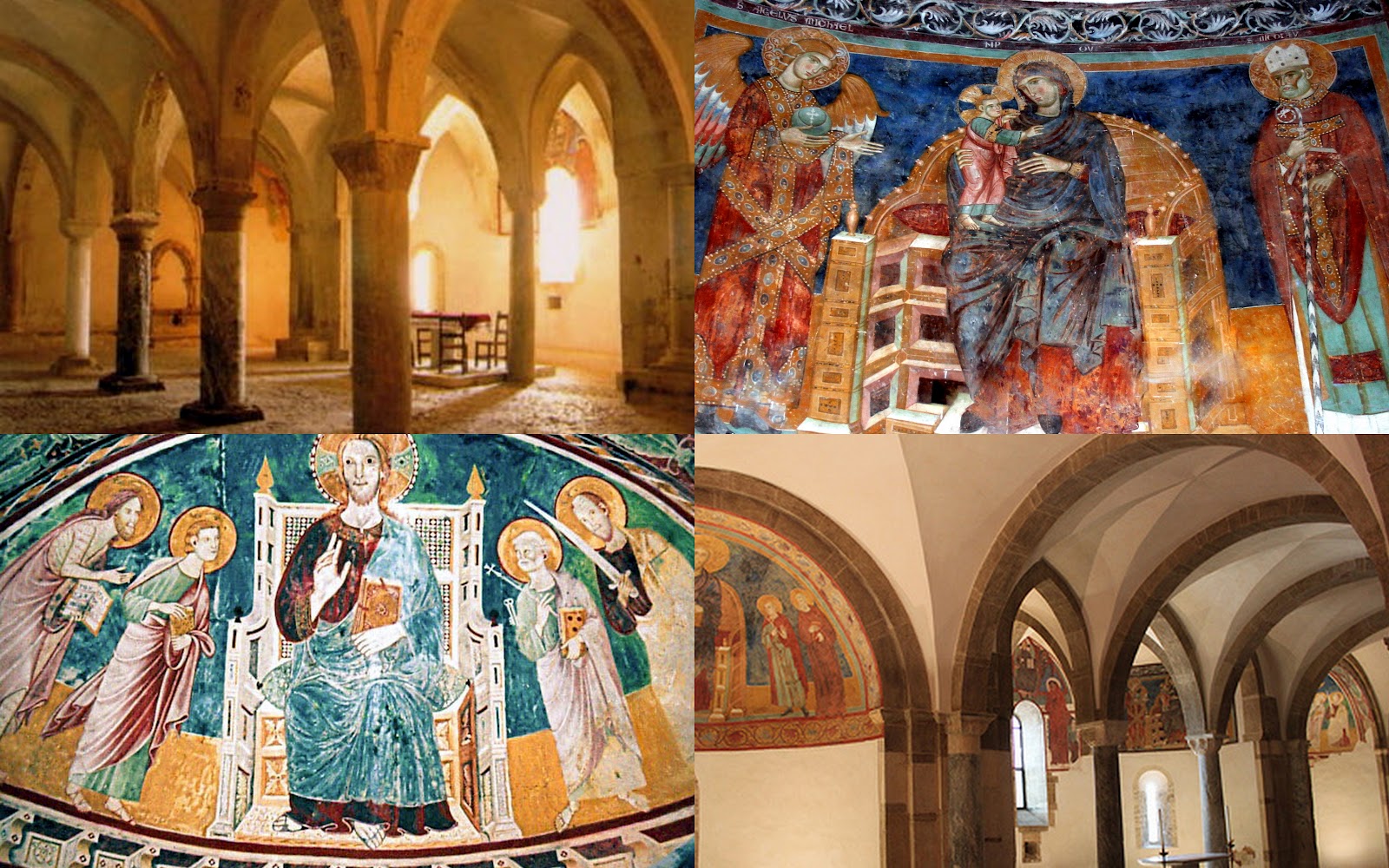
The interior is divided into three naves divided by twelve pillars with gothic arches and it has a high roof of wooden beams. Real treasure is to be found down in the crypt - marble pillars dating back to Roman times and frescoes dating back to the twelfth and thirteenth centuries. The frescoes were restored in October 2009. In the central fresco Christ is in the middle with saints Benedict and John the Baptist on either side. On the right wall is a panel with the Virgin and Child between the Archangel Michael and St Nicholas of Bari.
We ended the day with dinner in the café which is at the side of the abbey amid trees and flowers. They serve delicious pizza and gelato artigianale (home made ice-cream). You can see the Portale delle Donne – (women’s portal) in the background.
Here is a very short video showing the view from the abbey. It makes me what to be back there again...


Daniele, our guide, has several interesting itineraries for day trips in Abruzzo. See his website  for more details: http://www.abruzzowithyou.com/

Saturday, November 26, 2011

Trabocco Punta Torre, Abruzzo Coast

The traditional fishing huts that are dotted along Abruzzo’s coastline have intrigued me since I first saw them  in Francavilla al Mare in 1994. They are called Trabocchi (pronounced tra’bok-key) and last year Bodach of About Abruzzo had great close up pictures of them in his fascinating post Lunch on a Trabocco. I was thrilled that Daniele included a visit to one on his itinerary so that I could see one up close with my own eyes. This August we went to see Trabocco Punta Torre with him, just south of San Vito Chietino.

From the gravel path that leads to the trabocco, we crossed the wooden footbridge with sides made of rope. The trabocco is positioned where the sea has a suitable depth (of at least 6m) and is in the shelter of rocky peaks. A friendly local was here on vacation with his family and he took the time to show us around and answer our questions. This is typical of the warmth of the Abruzzese people.

How does a trabocco work?
Fishermen lower the huge meshed nets to the seabed from a platform at the back, then crank them up when full of fish by an intricate system of pulleys and winches.
                           

There is a large pole in the middle of the platform with a bar going through the centre horizontally. The fisherman pushes on this as he walks around in circles to raise or lower the large nets which are supported by four long arms of wood. He kindly showed Amy the fishing nets and pleased her by saying that he threw back any small fish that got caught.


What does a trabocco look like?
To me it looks like a tree house on stilts, joined to the shore by a long wooden bridge. The famous Italian writer Gabriele D’Annunzio describes one as:
‘A strange fishing machine all made of boards and beams, like a giant spider.’


There was a small kitchen inside the hut with a gas burner, table and sink. He pointed out that the rope hammock was not part of the original trabocco (but it blended in very well). He had even slept there for a couple of nights, but said that sometimes the sound of the waves crashing against the rocks kept him awake.

Some are completely original; others are skillfully reconstructed and made stronger to withstand the Mistral wind. They need regular maintenance and are made from locally sourced acacia wood and Aleppo pine as they are water and salt resistant.

How old are the trabocchi?
They are on average more than 200 years old and originally were used purely as a unique method of fishing from the land instead of using a boat. The trabocchi are a distinctive architectural element and have become a symbol of the history and culture of Abruzzo. The Trabocco Punta Torre was built by Domenico Verì in 1873 and is still owned by the Verì family.

Where can you find the trabocchi?
They stretch from the sandy beaches of Francavilla al Mare right down to the vineyards and olive groves of San Salvo, a coastline of incomparable beauty embellished by these structures. Along the old railway line there is a lovely bike path La Via Verde which follows the coast and would be a nice way to spend a day admiring these unique fishing machines as you cycle along Chieti province coastal cycle path.

Trabocchi Coast Fish Restaurants

How many trabocchi are still in use?
Numbers differ depending on which site you read, but according to some accounts there are about 28 trabocchi still in operation along The Trabocchi Coast. Most are private property; some open only for events such as the Cala Lenta.  Fifty years ago there were 65 of them. Then they began to disappear one by one and risked extinction. In 1997 a new law was made in Abruzzo to finance their revival and there was a renewed focus on eco-tourism and since then the trabocco has become a symbol of protection and a tourist attraction. Some of the trabocchi on the north pier of Pescara have been gradually stranded - they are no longer over the water but are surrounded by sand.

Which of the trabocchi are used as fish restaurants?
After a little research I found that at least seven of the trabocchi are used as fish restaurants:

1. Valle Grotte - San Vito Chietino
2. Punta Isolata - Punta Aderci
3. Pesce Palombo - Fossacesia Marina
4. Punta Rocciosa - Fossacesia
5. Punta Cavalluccio - Rocca San Giovanni
6. Punta Punciosa - Rocca San Giovanni
7. Punta Penna - Vasto Marina

They usually serve evening meals. (Click on the links to find out more information about them and how to get there. Some of the sites are in Italian - just press the google translate button at the top of the page.)

In recent years the owners of these ones have begun serving local fish dishes from June through September (dinner is a fixed price of €50 per person - reservations required).  There are many starters and the main course comes with homemade pasta. You can eat traditional delicacies such as octopus, anchovies, calamari, fish stew (brodetto), stuffed mussels and squid, shrimp  and prawns, seafood and fried fish of all kinds. Water, wine, coffee and dessert are also included in this price.

Next year I plan to return and have the experience of dining in one of these unique restaurants suspended over the Adriatic. The Trabocco Pesce Palombo looks like the perfect place for dinner by candlelight with a difference...


Daniele also brought us to Punta Penna Nature Reserve and the Abbey of San Giovanni di Venere on this day; read about our Journey to San Giovanni in Venere. See more of his great itineraries on his website:  http://www.abruzzowithyou.com/

Sunday, November 13, 2011

Cookout in Campo Imperatore

We left Santo Stefano di Sessanio in a hurry because Daniele, our driver, had told us that the place where we were going to eat in Campo Imperatore closed at 8pm. The road curved around mountain tops and wound its way through the Gran Sasso National Park past sheep and cattle tracks. Then we descended into a vast plateau and came across a herd of cows, some of which blocked the road for a few minutes! Slowly they made their way to the other side and we continued on.
Daniele told us that some of the Spaghetti Westerns - a sub-genre of Western films dating from the mid-1960’s - were filmed here (as well as in Spain). As we drove along past the miles of open, uninterrupted land surrounded by mountains - I could just imagine cowboys galloping by. It really does look like the old Wild West complete with semi-wild horses, golden eagles and peregrine falcons flying overhead. This unspoiled landscape provided the perfect background scenery for these films.
The Corno Grande in the distance
In the lower plateau of Campo Imperatore there are wooden log cabins that were originally built to equip the cinematographic sets of these legendary Spaghetti Westerns. Years later these cabins were left to the families of shepherds. Ristoro Mucciante is one of these and is open from April to October.

Inside the cabin they sell arrosticini (mini lamb kebabs - 1cm cubed lamb on sticks), sausages, pecorino cheese, beer, olive oil and some local wine.

Outside there are many wooden benches and tables scattered around and several burning braziers available so that you can cook your own meat after you purchase it. We cooked it in two batches, about 10 minutes for each one. It is a fun and very special way to enjoy typical Abruzzese food. The embers in the charcoal of the coal brazier (fornacella) were already glowing. The air temperature dropped to 18C so it was also a nice way to warm our hands, because we actually started to feel cold. It was strange, because back in Ireland 18C would be considered to be a warm summer’s day.
They provide the disposable plates, knives, forks and plastic cups, so you don’t have to bring anything of your own. The price for 50 skewers of arrosticini, bread, olive oil, 5 sausages, water and beer was €45 (not bad for a meal for 5 people)! If you'd prefer to have this food served to you rather than take the risk of cooking it for yourself, you could try the other Ristoro in Campo Imperatore that Bodach of About Abruzzo went to.


Arrosticini
I had my first taste of arrosticini on ferragosto 2007 and I loved them from the very first bite. Accompanied simply by sausages, crusty bread drizzled with delicious olive oil (from Loreto Aprutino) and Perroni beer this rustic traditional food was so enjoyable. The sun was setting as we took in the expansive surroundings, sitting out the middle of nowhere.


When the lights of the Ristoro went out Daniele put his car headlights on until we finished eating as we were the last to leave. Then he announced dramatically “and now for the light show - everyone look up” …

He switched off the headlights and we were awe-struck as we gazed up at the layers of thousands of stars in the black night sky. We could even see the Milky Way directly above us. It was truly an amazing sight, humbling and magical, and a perfect end to an unforgettable day…
The mesmerizing Milky Way
Where is Campo Imperatore?

Click on map to enlarge

Thursday, October 20, 2011

Spellbinding Santo Stefano di Sessanio

Piazzetta, Santo Stefano di Sessanio

Leaving the Rocca Calascio we continued on towards Santo Stefano di Sessanio in the heart of Abruzzo. Ever since watching the movie ‘The American’ starring George Clooney, I’ve wanted to visit this scenic 16th century hill village. It looked absolutely stunning, just as it did in the film, apart from the sad loss of the tower in the 2009 earthquake. It was picture perfect; around every corner was a different postcard scene. It is no surprise that it has won the award for being one of the most beautiful villages in Italy. Abruzzo has many alluring, ancient hill towns rivalling those of Tuscany and Umbria and the region has won 19 ‘Borghi Piu Belli d’Italia’ awards which is more than any other region in all of Italy.

Traditional Crafts

On entering the village I felt as if I was walking into a different era. There were many talented craftspeople displaying their trades.
Weaving the seat of a chair


Lace-making in the piazza
Being less than two hour's drive away from Rome, nowadays the people here depend on tourism as their main source of income. In the past seven years typical aspects of village life were revived when local artisans were encouraged to move in and set up workshops. They help preserve the identity and culture of their region. With its quaint little artisan shops, art galleries, restaurants and cafés tucked into ancient stone buildings, it provides everything you could want.

Artigianato Artistico
In the handloom weaver’s shop local women weave woollen bedspreads, rugs and throws for sale. Others make linen embroidered bed sheets and lace pillowcases. In the tiny food stores you can purchase locally produced salami, mountain cheeses, homemade breads, jars of wild saffron, jams and pots of honey. There is also a potter’s kiln with hand-made ceramics that you won’t find anywhere else.

On the first weekend of September each year is the lentil festival Sagra delle Lenticchie which celebrates their famous brown lentils. Hundreds of people come to enjoy tasting different lentil dishes.

The village

We enjoyed walking through the village enjoying its sounds, smells and beauty and best of all - no traffic, apart from the odd Ape or Vespa.


We meandered around the labyrinth of narrow, charming cobblestone streets, ancient stone houses with flower-filled balconies, steep stairways, arches and tiny piazzas which characterize Santo Stefano di Sessanio.

Porta Lorda
Piazza di Capo Castello

There is a gorgeous view from the top of the village of the charming historic villages of Castelvecchio Calvisio, Barisciano and Carapelle Calvisio that surround the Gran Sasso National Park.

The village faces the Navelli plain. Its historic stone houses with thick walls and small windows huddle up close to one another around the perimeter. The alleys are bridged by picturesque archways.
Porta Medicea and the coat of arms of the Medici family with five balls
I loved the elegant arches on this gorgeous building ‘The Palazzo del Capitano’ with its Renaissance style gallery.
Palazzo del Capitano
Daniele, our guide, brought us through this narrow gap in the wall called ‘La Buscella’; a place where it is said that in medieval times, young lovers met to steal fleeting kisses, not being able to do so publicly.
La Buscella
Francesco Hayez - The Kiss (1859)

Recent restoration

Since 2004, about a quarter of the ancient houses have been restored by entrepreneur Daniel Kihlgren (44). I found a fascinating article about him here.

With the support of architects, historians, the Abruzzo folk museum and the regional tourist board, he succeeded in reviving the village and giving it back its genuine medieval feel. His hotel Sextantio Albergo Diffuso has rooms in various buildings throughout the village. During the reconstruction, local tradesmen remained as faithful as possible to the artistic style of the past.

Sextantio Albergo Diffuso
George and the film crew stayed here during the making of the movie. Rooms have original rustic open fireplaces and pre-war peasant furniture gleaned from local markets and antique stores. I would love to return  for a few days and immerse myself in this mountain village lifestyle.

The Tower

The twisting paths that wind between the houses lead to the spot where the Tower used to stand. Now the metal scaffolding glistening in the sunlight gives hope that the tower will soon return to its former glory.

Restoration has already started and I read that it is due to be completed by 2013. I hope to return to Santo Stefano when this is done and see that magnificent view from the top of the tower. There was so much that we didn’t get to see during our short tour: the restaurants, the art galleries, the attractive church of Madonna del Lago at the edge of the lake - so many reasons to return.
Piazza Medicea
We stopped for an aperitivo in a small piazza before heading off to Ristoro Mucciante for dinner. More about our evening meal in Campo Imperatore in my next post…

If you appreciate nature and are interested in local ways and culture you’ll love Santo Stefano di Sessanio. It gives you a glimpse into the authentic peasant life of a century ago, softened by modern conveniences.

Further reading:

Santo Stefano di Sessanio by abruzzoupndown

Medici memories by Bodach of About Abruzzo

Icons of Beauty - George Clooney and Abruzzo in The American by Sammy of Life in Abruzzo