Showing posts with label Italian films. Show all posts

Sunday, November 13, 2011

Cookout in Campo Imperatore

We left Santo Stefano di Sessanio in a hurry because Daniele, our driver, had told us that the place where we were going to eat in Campo Imperatore closed at 8pm. The road curved around mountain tops and wound its way through the Gran Sasso National Park past sheep and cattle tracks. Then we descended into a vast plateau and came across a herd of cows, some of which blocked the road for a few minutes! Slowly they made their way to the other side and we continued on.
Daniele told us that some of the Spaghetti Westerns - a sub-genre of Western films dating from the mid-1960’s - were filmed here (as well as in Spain). As we drove along past the miles of open, uninterrupted land surrounded by mountains - I could just imagine cowboys galloping by. It really does look like the old Wild West complete with semi-wild horses, golden eagles and peregrine falcons flying overhead. This unspoiled landscape provided the perfect background scenery for these films.
The Corno Grande in the distance
In the lower plateau of Campo Imperatore there are wooden log cabins that were originally built to equip the cinematographic sets of these legendary Spaghetti Westerns. Years later these cabins were left to the families of shepherds. Ristoro Mucciante is one of these and is open from April to October.

Inside the cabin they sell arrosticini (mini lamb kebabs - 1cm cubed lamb on sticks), sausages, pecorino cheese, beer, olive oil and some local wine.

Outside there are many wooden benches and tables scattered around and several burning braziers available so that you can cook your own meat after you purchase it. We cooked it in two batches, about 10 minutes for each one. It is a fun and very special way to enjoy typical Abruzzese food. The embers in the charcoal of the coal brazier (fornacella) were already glowing. The air temperature dropped to 18C so it was also a nice way to warm our hands, because we actually started to feel cold. It was strange, because back in Ireland 18C would be considered to be a warm summer’s day.
They provide the disposable plates, knives, forks and plastic cups, so you don’t have to bring anything of your own. The price for 50 skewers of arrosticini, bread, olive oil, 5 sausages, water and beer was €45 (not bad for a meal for 5 people)! If you'd prefer to have this food served to you rather than take the risk of cooking it for yourself, you could try the other Ristoro in Campo Imperatore that Bodach of About Abruzzo went to.


Arrosticini
I had my first taste of arrosticini on ferragosto 2007 and I loved them from the very first bite. Accompanied simply by sausages, crusty bread drizzled with delicious olive oil (from Loreto Aprutino) and Perroni beer this rustic traditional food was so enjoyable. The sun was setting as we took in the expansive surroundings, sitting out the middle of nowhere.


When the lights of the Ristoro went out Daniele put his car headlights on until we finished eating as we were the last to leave. Then he announced dramatically “and now for the light show - everyone look up” …

He switched off the headlights and we were awe-struck as we gazed up at the layers of thousands of stars in the black night sky. We could even see the Milky Way directly above us. It was truly an amazing sight, humbling and magical, and a perfect end to an unforgettable day…
The mesmerizing Milky Way
Where is Campo Imperatore?

Click on map to enlarge

Sunday, October 2, 2011

The Magic of the Rocca Calascio


I finally succeeded in visiting the dramatic Rocca Calascio after a long time wishing to see it. The problem has always been getting there. We haven’t been brave enough to rent a car in Italy yet and have managed most of our trips so far around Abruzzo using buses and trains. The journey is through mountainous terrain with narrow rocky roads, many of which have no guardrails.

By bus from Pescara you have to change at L’Aquila and wait for four hours there to get another one to Calascio. As there is no bus back in the evening you would have to stay there overnight. Fortunately for us we discovered Daniele, a guide/driver for the region who speaks English and includes the Rocca Calascio in his tours.

Getting There

Daniele departed from Pescara in the direction of Rome and left the highway at the Bussi exit. We stopped along the way and marvelled at the atmospheric, ancient Abbazia di San Clemente in Casauria. It was built in 871 AD and just recently reopened following restoration after being damaged in the April 2009 earthquake.
Interior of Abbazia di San Clemente


Next we made a short stop at the church of San Pietro ad Oratorium with its ‘magic square’ (on the left hand side of the main portal) and we admired the crystal clear Tirino river near Capestrano.

Chiesa di San Pietro ad Oratorium

The Tirino River is claimed to be the cleanest in Europe

Then he drove in the direction of L’Aquila, turned at Ofena and continued on to Calascio. The whole journey took about an hour and a half. He bravely negotiated the breathtaking winding roads up to the small medieval village of Calascio at the foot of the castle. These roads are so narrow that when we met a string of cars going in opposite direction there was no room to pass; so the cars in front had to reverse back to a safe spot.

On another bend there was a break in the guardrail as if a car had crashed into it and the two sections were held together with a string of red and white striped ribbon to prevent cars from going over the edge!

The Village of Calascio

The houses in the village of Calascio curl around the base of the mountain forming a defensive wall. The startling scenery around it is of rugged towering mountain ranges over valleys and immense plains. We rambled through the narrow village streets and stopped at the Rifugio della Rocca, a charming small restaurant and hotel with a simple, rustic and cozy interior. If you take the bus this would be a lovely place to spend the night. Sheep graze on the hillsides around and the villagers cultivate lentils and saffron in the valley below.
Rifugio della Rocca, Calascio
Interior of Rifugio della Rocca

The Church of Santa Maria della Pietà

Reva, an American girl who is working her way around Italy, joined us for this tour. She also has an interesting blog about her travels called Here’s to Italy. Together we hiked from the village following a rocky path towards the impressive white limestone fortress. The day was sunny and hot 32C (96F) with incredibly clear blue skies. Halfway up the hill we passed the beautiful octagonal church of Santa Maria della Pietà standing on a solitary plateau.

Santa Maria della Pieta with the Corno Grande in the background
It was built between the 16th and 17th centuries, when the Rocca Calascio was the property of the Medicis. The door of the church was open and being curious we headed towards it eager to see how it looked inside. We considered ourselves fortunate as Daniele said that it was usually closed. Alas, there was a private ceremony taking place and we were not allowed to enter. John however got a chance to take this quick photo of the interior from the doorway with his phone.
Interior of Santa Maria della Pieta

The Fortress of Calascio

A little history: At 1460m above sea level the Rocca Calascio is the highest and one of the oldest fortresses in Italy. It was built as a single watchtower in the tenth century for military purposes. There is a walled courtyard with four cylindrical towers at the corners. A taller inner tower was added in the thirteenth century. It was badly damaged by an earthquake centuries ago and never rebuilt so now only the exterior walls remain. Even though it is in ruins it still looks imposing. This drawing by Silvio Germano shows how the Rocca Calascio would have looked in the thirteenth century…
Before getting to the drawbridge you have to climb over a very stony patch and there is no rail to hold on to.

We wandered through the fortress and the wonderful weather provided us with clear views for miles over the magnificent terrain: Campo Imperatore, the Navelli plain and the majestic Gran Sasso Mountains. The absolute silence, the immensity of the surroundings and the high mountains create magical views from the top of the fortress. The atmosphere here is of the Medieval Ages, a place between reality, fantasy and imagination, silence and solitude.

The Rocca Calascio in the province of L’Aquila is one of the most magical places in Abruzzo and this entire day made wishes come true for me. If you are looking for a guide we highly recommend Daniele. He is enthusiastic, friendly and generous and delighted to share his intensive knowledge of the region with visitors. Let yourself be carried away by the Rocca Calascio, its history and the beauty of its breathtaking landscape.

Further reading:
The Spectacular Castle, Rocca Calascio by Tatiana of Italian Slow Walks
Filmed in Abruzzo and Rocca Calascio by Bodach of About Abruzzo
An Italian Fort Worth a Walk To by Sammy of Life in Abruzzo
Getting to Calascio by Christina of Searching for Calascio

Wednesday, September 21, 2011

A Day in Bologna

If you are visiting Rome, Florence, Milan or Venice it is worth planning a detour to experience the architectural, artistic and culinary delights of beautiful Bologna. This summer was our fifth visit to this alluring, colourful city. Usually we stay for just a couple of nights but on a day trip you could manage to see several of the main attractions.
Piazza Maggiore, Bologna

What exactly can you see in just one day you may ask? Well, the city centre is quite compact so it’s easy to get around on foot. Some great things about Bologna that I like are that:

• Private cars are banned from the city centre during the day
• The museums are free to visit (except for the Pinacoteca Nazionale)
• There are many food markets and a huge weekly market (Friday and Saturday)
• The porticoes shelter you from the sun or the rain
• The food is amazing ( it is the unofficial culinary capital of Italy)
• It has the world's largest perfectly preserved medieval city centre

Piazza Maggiore, the magnificent main square is a good place to start. Get a free map of the city in the large tourist information office opposite the cathedral before you begin your exploration. First off, inside the gothic interior of Basilica San Petronio on the left of the square, there is an interesting Zodiacal sundial 67m long on the floor. It was created by astronomer Domenico Cassini in the 17th century. If you look up you’ll see a tiny window in the apse where the sun shines through illuminating the meridian line which shows the exact period of the current year.

The Palazzo Comunale (Palazzo d'Accursio), the elegant adjacent building, is home to three museums with many illustrious and priceless works of art throughout. A huge Bramante stairway leads to the first floor; the low, wide steps were to allow those on horse-back access to the upper floors. The museum of painting and decorative objects on the first floor has richly frescoed ornate rooms with lovely views of the piazza from the windows. In the Sala Farnese on the second floor, the ceiling from the 1800’s is beautifully illustrated. If you are interested in art you’ll enjoy the Morandi museum on the third floor. It contains about 200 paintings by Bologna born artist Giorgio Morandi (1890-1964) the greatest Italian still life painter of the 20th century. The collection spans his career from youth to maturity.

Museo Morandi

Leaving the building around the corner you’ll find yourself in the adjoining Piazza di Nettuno. Take the time to admire all the details of the stunning Neptune fountain.

Fontana di Nettuno Bologna
Palazzo Re Enzo on the right
Continue down the street towards the Two Towers. The russet, orange, ochre and yellow of the surrounding buildings are magnificent and most of the roofs have red terracotta tiles. If you climb the 498 steps to the top of the Asinelli tower at the end of this street you can see them and view a marvellous panorama of the city.
Bologna's iconic Two Towers
Garisenda and Asinelli

Near the Two Towers is the gorgeous, atmospheric, Piazza Santo Stefano – a must-see.

The tranquil church of Santo Stefano is a unique cluster of 7 churches and temples with two cloisters attached dating from the 8th century. It is fascinating to wander around these stunning churches and see the different styles of architecture within. Stop for a coffee at the charming café nearby and soak in the ambience of serenity. (By the way, in addition to your coffee many places here serve a complimentary glass of acqua frizzante.)

Head towards Via Clavature to see the amazing sculptures in the Santuario Santa Maria della Vita (which I wrote about in my previous post) and then explore the tiny side streets with many small food shops in the medieval market area. There are fishmongers, vegetable vendors, chocolatiers, homemade pastas, salumi (cured pork, beef, lamb or veal) and cheeses at La Baita. Check out the mouth-watering pastries and the panificio on via Orefici. Bologna has so many good restaurants, trattorias and osterias; I believe that no matter where you choose to eat in this city you’ll have a wonderful meal. If you want a quick takeaway lunch Pizzeria Il Mascalzone on via dell'Indipendenza is the place to go.

Now for one of Bologna’s secrets…If you continue walking down towards via Piella and cross a bridge you’ll come to a wall with a little window cut out in it about two feet square. When you look through this window you’ll get a surprise…

Piccola Venezia, Bologna
Last summer our friend Enrico pointed this out to us. I don’t think that we would have ever discovered it by ourselves. He said that not many tourists have come across this window, but now you know where to find it! It is also known as Piccola Venezia, the last of the canals of Bologna which date back to the 12th century.

The shops re-open about 3.30pm. One of my favourites is the Feltrinelli bookstore. I always return from Italy with Italian books, CDs or DVDs.
La Feltrinelli bookstore Bologna
via Zamboni

Lastly, you could end your day with a hike up to the beautiful Santuario di San Luca. We first went there in August 1998 so the photos below are scanned. The sanctuary is located on the hill that oversees the entire city. Take bus number 20 from the city centre to the stop at the Meloncello Arch. Bologna has a frequent and efficient bus (and train) service. From here it is a 4k walk to the church at the top under the world's longest portico of 666 arches and you'll pass 15 frescoed chapels along the way. Built in the mid 18th century it offers lovely views over the city and countryside.

You could have dinner up here in the evening at Trattoria Meloncello or back down in the centre where there is such a large choice of superb restaurants including Ristorante Biagi, Osteria al 15 and Da Cesari.

During July and August there are free films outdoors on a giant screen in Piazza Maggiore at 10pm. With a gelato in hand, sitting in the piazza, watching a movie in the open-air on a warm summer’s night is a magical way to end a day in Bologna. You could easily spend a week here and still not see all it has to offer!

Open-air cinema Piazza Maggiore Bologna
image courtesy of http://www.tafter.it/
If you are here for more than one day you could visit the  three main museums: the Medieval City Museum, the Archeological Museum and the wonderful Pinacoteca. Bologna gives you so many things to do and see but it's up to you to choose how to experience this fascinating city. Have you been to Bologna yet? What would you include as a must-see here?

Update: For a walking itinerary in Bologna complete with an interactive map have a look at this excellent post at https://delightfullyitaly.com/2015/03/08/bologna-in-one-day/

My other post about Bologna: A Night in Bologna

Tuesday, November 16, 2010

Piazza del Popolo - Ascoli Piceno

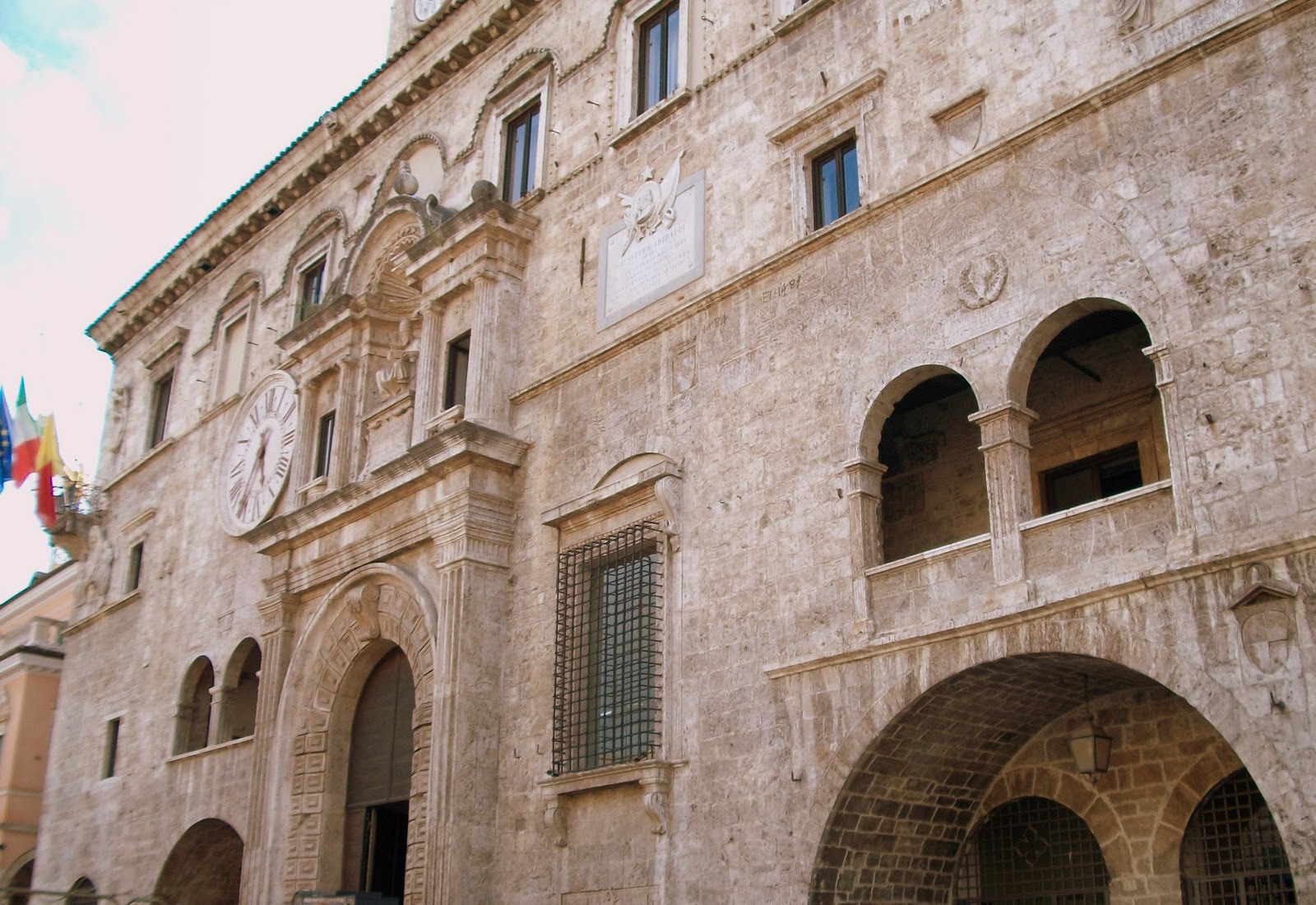
When I first entered Piazza del Popolo, the beauty of the surrounding buildings took my breath away. This large square in the heart of Ascoli Piceno (see map) paved with gleaming travertine and flanked by Renaissance porticoes, is the setting for the city's finest buildings - the Palazzo dei Capitani, the Church of San Francesco and a line of lovely colonnaded stores (the Loggia dei Mercanti).

Piazza del Popolo - the heart of Ascoli Piceno
Piazza del Popolo- The People’s Square - is the place where everyone gathers to meet, to watch, eat, shop and take their evening stroll, the passeggiata. There are many restaurants here serving local cuisine at reasonable prices. Another wonderful thing about this piazza and nearby Piazza Arringo, is that they are traffic free zones so you don’t have to worry about a car or a scooter startling you as you stroll around. This gives the town a very special ambience of tranquility and serenity and makes it magical by both day and night.

View of Sibillini hills from Piazza del Popolo
Surrounding the town are the Sibillini hills and only thirty minutes away is the beach at San Benedetto del Tronto, making it a perfect location, well serviced by public transport. It is a thriving town with a well-preserved historic centre. Its pretty side streets are like warrens, inviting you to explore them. Everyone we met was really friendly. For example, when we entered Palazzo dei Capitani, the woman at the desk offered to give us a guided tour. The façade of this building has a sculpted portal with a monument to Pope Paul III and a beautiful large stone clock. Inside she showed us the pretty three-tiered Renaissance courtyard surrounded by arcades, the seat of council on the first floor and an underground archeological route with Roman ruins below.

Palazzo dei Capitani


View of Loggia dei Mercanti from Palazzo dei Capitani

Our friend Stefano suggested that we have a caffe corretto all’anisetta in the adjacent building, the famous                Caffè Anisetta Meletti.
 Anisetta is a sweet, delicious aniseed-flavoured liqueur. It gave us a warm feeling as we sat beneath the frescoed porticoes with elegant arches and watched the action in the square. The service was very attentive, but not intrusive. This Café has been featured in many films, commercials and photo shoots.
Caffe Anisetta Meletti - Piazza del Popolo


Caffe corretto all'anisetta
In business since 1907, the interior retains its Art Deco style, with rich, warm woodwork and a décor that takes you back in time. I was especially drawn to the round Carrara marble topped tables with scenes from films that were set in this café, the most famous of which is possibly

A scene from 'I Delfini' (1960)
Left to right: Anna-Maria Ferrero, Gerard Blain, Claudia Cardinale

Tabletops in Caffe Meletti
Next we went to the Church of San Francesco at the top of the square. It has three gothic portals sculpted from travertine and two bell-towers. Inside, the stained-glass windows have different stories to tell as they filter light throughout the interior. In the left nave is a crucifix that miraculously survived a fire and is reported to have spilled blood twice.
Interior of Chiesa di San Francesco
Last but not least, the Café Lorenz to the left of the church sells takeaway stuffed olives, a speciality of the region called “Olive all’Ascolana”. I usually find green olives quite bitter but was encouraged to try these and discovered they were surprisingly delicious! They are large green Picene olives, stuffed with mixed meats, usually pork and veal, breaded, deep fried and served hot. You can also find these in Piazza Arringo at a vendor named Migliori.

Takeaway  'Olive all'Ascolana'
In the opening scene from the film 'I Delfini' there is a marvellous panorama of Ascoli Piceno followed by atmospheric shots of Piazza del Popolo and the exterior of Caffe Anisetta Meletti.


I hope that between this and my previous post, I’ve given you enough reasons to take a day trip to amazing Ascoli Piceno.

Friday, July 24, 2009

Mid-August Lunch in Capestrano

Italians have perfected the art of eating al fresco. I think that food eaten outdoors always tastes so much better. Our friends have relatives who live on a farm in Capestrano in the fertile valley of the Tirino River (about 30k west of Chieti)  and we had a most memorable lunch there to celebrate Ferragosto. This post demonstates the generous hospitality of the people of Capestrano. Here’s how it went:

A small three-wheeled vehicle known as an Ape (pronounced ah-pay), along with a tractor and trailer provided transportation from the farmhouse for the food, water, wine, extra chairs, (lovely) tablecloths…and the children! They chose a perfect spot for the lunch under the shade of a large old olive tree, surrounded by the majestic Gran Sasso mountains, the crops and the vineyard. The trailer was used as an extension to the main table as there were 18 of us. We helped set the table and lit citronella candles to keep the flying bugs away.Ubaldo is a small farmer and also tends a vineyard where he produces enough wine for everyday use for his family and friends. One of the wines for the lunch was a crisp, white Trebbiano that went well with the starters. The other was a robust red Montepulciano d’Abruzzo that complimented the meat dish perfectly. Everything we ate was either grown on the farm or homemade (apart from the rice salad that our friends brought along). The people of Abruzzo have ancient food traditions; their dishes are simple and characterized by genuine foods, rich in taste and aroma.

For the antipasto we had grilled sweet corn on the cob. (You can see the cornfields in the background.) The primo consisted of the rice salad, with bruschetta drenched in homemade olive oil alongside grilled red peppers. The home-grown tomatoes were so flavorsome.This was followed by a traditional Abruzzo meat dish called ‘arrosticini’ for the secondo. It is probably one of the simplest and tastiest examples of Italian-style grilled pieces of lamb on skewers. You eat it in your hands and use your teeth to slide the meat off the skewer piece by piece. A special long narrow grill called a ‘fornacella’ was used to cook the lamb. It is a local invention that can only be found in Abruzzo. (Arrosticini can also be cooked on a regular charcoal grill.)To cleanse our palates after the meat we had a delicious slice of chilled watermelon. The dolce consisted of traditional Abruzzo type waffles called Pizzelle. They have a flower design instead of a squared pattern and have the excellent light taste of a crispy vanilla flavored biscuit. Two of them were sandwiched together with Nutella and they were relished by both children and adults alike. To me, one of the nicest things about long warm summer days is being able to enjoy good food, good wine and good company - all'aperto - in the open air!

My other post about Capestrano: The town of Capestrano

Update:
After writing this blog post I discovered an Italian movie about the same subject and I just had to see it; but what a very different pranzo it was! If you like Italian comedies you will love this one. It was absolutely delightful!


*******************************************

Pranzo di Ferragosto in Abruzzo
Gli italiani hanno perfezionato l’arte di mangiare al fresco. Penso che quando il cibo e' mangiato all’aperto il gusto è sempre migliore. I nostri amici hanno dei parenti che abitano in una fattoria a Capestrano nella valle del fiume Tirino (circa 30k a ovest di Chieti)e abbiamo avuto lì un pranzo di ferragosto indimenticabile. Ecco com’è andata…

Un piccolo veicolo a tre ruote chiamata un Ape ed un trattore con rimorchio, trasportavano dalla casa colonica il cibo, l’acqua, il vino, le sedie, le (bellissime) tovaglie...ed i bambini! Avevano scelto un bel posto sotto l’ombra di un vecchio albero d’ulivo per il pranzo, circondato del maestoso Gran Sasso, i raccolti dei campi ed il vigneto. Il rimorchio era usato come una seconda tavola, perchè eravamo in 18. Aiutavamo ad apparecchiare la tavola ed accendevamo le candele di citronella come insettifugo.
Ubaldo è un piccolo agricoltore che gestisce anche un vigneto dove produce abbastanza vino per l’uso quotidiano della sua famiglia ed i suoi amici. Uno dei vini per il pranzo era un Trebbiano, frizzante e bianco che andava bene con l’antipasto. L’altro vino era un rosso e robusto Montepulciano d’Abruzzo che si completava con la carne perfettamente. Tutto ciò che mangiavamo, proveniva dalla sua fattoria o era fatto a mano (a parte l’insalata di riso che i nostri amici ci portavano). Le montagne abruzzese hanno una gastronomia tanto antica, quanto semplice, caratterizzata da alimentari genuine e piatti ricchi di sapori e profumi.

Per l’antipasto avevamo le pannocchie di mais alla griglia. (Si puo' vedere i campi di grano sullo sfondo.) Il primo era composto dall’insalata di riso con bruschetta inzuppava con l’olio di oliva fatto in casa, e con i pepperoni rossi grigliati. I pomodori locali avevano un gusto meraviglioso. Per il secondo mangiavamo gli ‘arrosticini’; essi sono degli spiedini di carne d’agnello, tipici della cucina tradizionale abruzzese. La preparazione consiste in carne ovina tagliata a tocchetti ed infilata in spiedini, la cui cottura avviene su un braciere dalla caratteristica forma allungata definito ‘fornacella’. Si mangia con le mani e si usano i denti per togliere la carne dallo spiedino. (Si possono arrostire gli arrosticini anche sul barbeque).
(La foto sopra e' da Wikipedia)

Per pulire i palati dopo la carne, mangiavamo una fetta d’anguria servita fresca. Come dolce c’erano le pizzelle, leggeri e croccanti biscotti d’Abruzzzo. Sono ottime dal gusto molto delicato. C’è un disegno di fiori all’esterno. Avevamo due biscotti inseriva con Nutella e li apprezzavano sia i bambini sia gli adulti.

Secondo me, una delle cose più belle dei giorni lunghi e caldi d’estate è di poter godere del buon cibo, del buon vino e della gioia di essere in buona compagnia -- all'aperto!